
How to surf intermediate
Turning and board control
As an intermediate surfer you know how to get up and take waves in the white water and are ready for further challenge. The next thing you need to learn is how to control your board when you surf.
Speed
To get speed while surfing you must maintain a correct position and put your weight of your body forward on the board. Just enough to keep the board flowing, so make sure the tip is not sinking into the water.
Slowing down
The opposite as how to create speed. You need to put your weigh in the back of the board.
Left and right
Start looking toward the side you want to go. When standing up on the board bend your hands a bit toward the side you’re going and put all your weigh toward this side until the board starts turning.
It can be a bit different when surfing longboards. Here sometimes it can be better to press the tail and moderately put more weigh in the back of the board to create more movement and more control. Turn your eyes and body in the direction you want to go and bend your knees.
How to get into the line up
You have already entered the world of surfing and learned all the basic. You know how to easily stand up on the board and control it while surfing in the white water. Now you’re ready for the next level: surfing green waves in the line up.
Beach break or point break
The first thing you need to learn is how to get out in the line up. First you wait for a good moment to enter the impact zone (the area between the white water and line up). The water needs to be as calm as possible before you start paddling. Waves comes in sets so you might have to wait for a set to be over.However there will almost always be waves in front of you when you paddle out and you would have to pass these. It is inevitable, but you have 3 options on how to do it:
1. Throw the board: The Hawaiian
The Hawaiian is a technique where you take your board in both hands and throw it next to you. You should always check your surroundings before letting the board go and make sure you won’t harm anyone. Once the board is dropped you swim under the wave. When the wave has passed you touch your leash and pull with it, so your board gets close to you again. Then you jump on the board and continue paddling.2. Push up
The push up is one of the most used by longboard surfing and is a great technique to pass over the a wave. When doing the push up you paddle strong toward the wave to create a lot of speed. Once you’re close to the wave you place both hands on the sides of the board and hold. Then you pull your body upwards – as you would when doing a regular push up. This technique is only recommended to do in green waves or with white waves that are small to medium in size. If the wave is too big, it usually then contains too much power and will pull you back toward the shore.3. Turtle roll
The Turtle roll is the most used and recommended technique when passing waves. Here is a step-by-step guide:1. Get ready when a wave is approaching you and has a distance of 2 meters.
2. Hold strongly the sides of the board. You hands should be placed a little higher than where your head is.
3. Turn your body to one of the sides and down in the water while still grabbing the board and making it turn with you. It needs to be a 180° turn, so you are down in the water with your board facing up.
4. When your body is under water you hold strongly the board.
5. Once the wave has passed you do a 180° turn again so you’re back in your starting position with you laying on top of the board. Then you continue paddling.
Your first green wave
How to read a green wave and make a bottom turn.
Reading waves is a subject of much explanation, understanding and practice. But we will provide you some steps to take when reading the waves and deciding which green wave you wanna try.
When you reached the line up you should first of all sit down on your board and take a break. This will help you keeping balance and gain energy again after the paddling out.
Reading waves is not an art of magic. It requires observation and patience. First you need to check what direction the wave breaks to and if you need to go right or left. If the peak of the wave is breaking toward the right side, then you surf to the left. And opposite, if the wave is breaking toward the left side, then you should surf to the right.
When you have chosen a wave and know the direction you start paddling when it is close to you. Try to maintain a good speed and then paddle hard when you feel the wave.
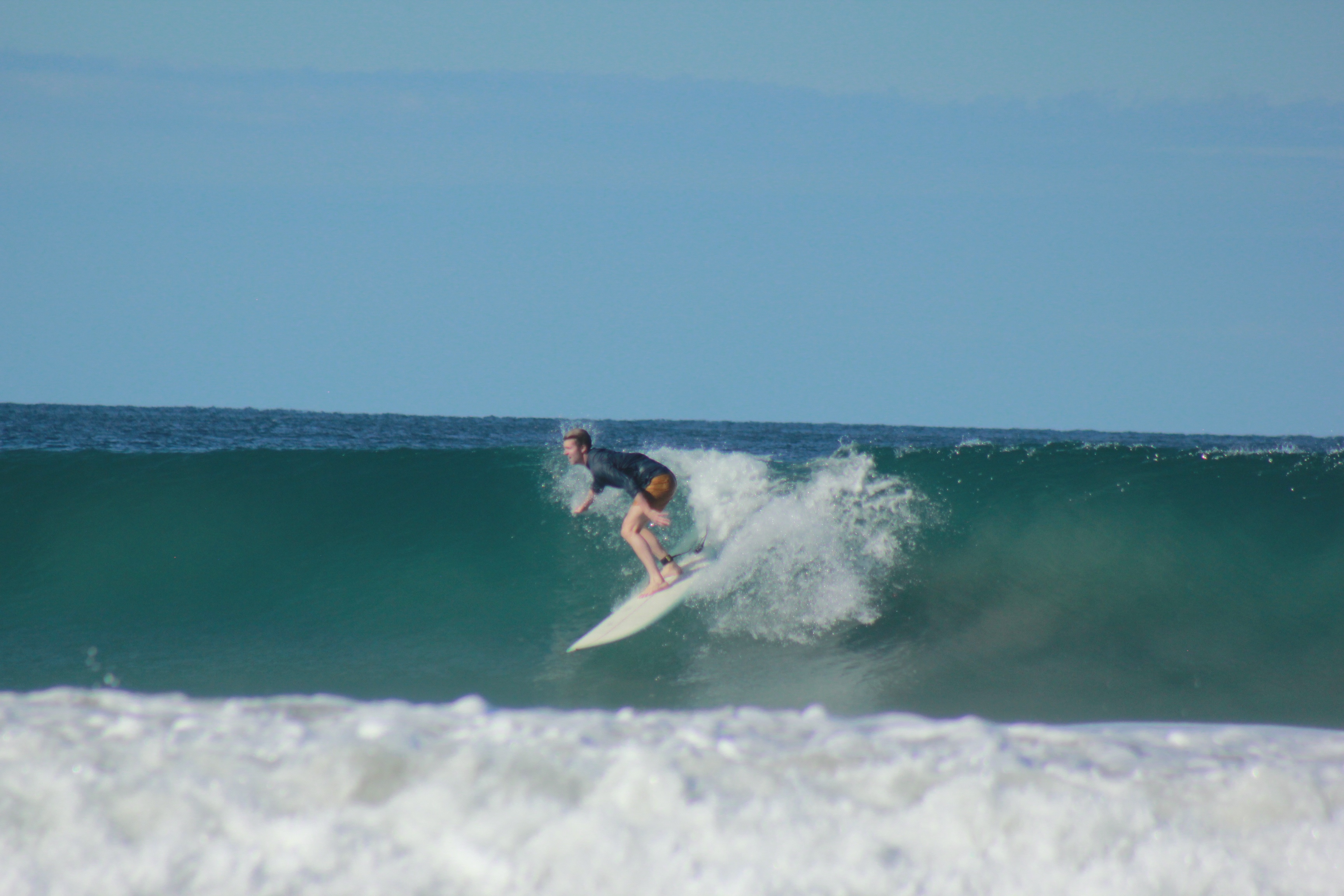
Once you feel the wave has taking you and it feels almost as if you’re going to “fall” into the water you stand up and go down the wave. Then you turn to the correct direction.
Keep practicing over and over.
Safety and accidents
When surfing green waves there are always a lot of things you need to take into account and be aware of – for your own and others’ safety.
– If you’re panicking or don’t know what to do in the water, the best option is always to drop your board. Take some breaths and wait for the waves to pass you.
– Always give priority to the surfer who is on the wave. Don’t take waves from other people if they are positioned better.
– When you fall of the board and into the water, try as quickly as possible to get on the board again and paddle back to the rest zone. Sometimes you might have to wait for the ocean to calm down again.
– Always protect your head with both hands when falling of the board.
– If you see a surfer coming near you and you feel lost on what to do, the best thing is to paddle away from their direction.
– Always surf with confidence and believe in your own surfing skills.